

Residing in Nabi Bakhsh Palari, a village situated on a small island in Kenjhar Lake, Kamal Palari was renowned for his bird-hunting prowess across Thatta, Hyderabad, and Jamshoro. However, in 2008, his life underwent a significant transformation when he established a friendship with a World Wildlife Fund official, leading to a complete shift in his identity.
He oversees wildlife protection in his village by managing a Community Reserve Zone designated as a Protected Area.
"Hunting birds is a distant thing; now aerial firing is also prohibited here," Kamal says.
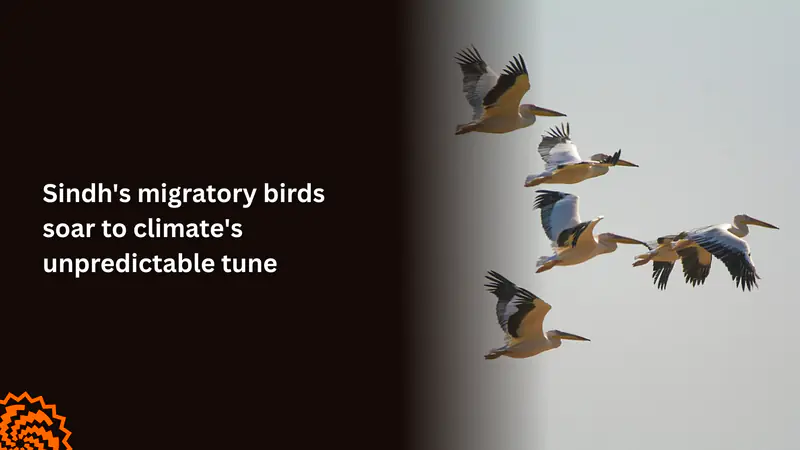
Kenjhar Lake, like other lakes in lower Sindh, serves as a habitat for migratory birds arriving from the north.
Every year, these migratory birds cover thousands of miles from Siberia and Central Asia, settling in the lakes of Sindh between December and January.
The fluctuations in human activities and alterations in water reservoirs, attributed to climatic variations, directly impact these migratory birds' numbers, health, and survival.
52-year-old Kamal Palari, seated in his otaq (guest room) surrounded by neem, acacia, and devi trees, told Lok Sujag in his Kohistani accent that following the floods of 2022, the usual influx of migratory birds to Kenjhar Lake has noticeably diminished.
Haroon Palari, Kamal's maternal cousin and an avid wildlife photographer, has been actively conserving and tallying the birds arriving at Kenjhar Lake for the past 12 years. Haroon concurs with Kamal's observation.
Haroon said that during his recent count, he identified 52 fire crows and 12 Gargene ducks, a stark contrast to previous counts where their numbers used to be in the hundreds.
Rasheed Ahmad Khan serves as the deputy sanctuary warden for the wildlife department in two districts of Sindh: Thatta and Sajawal. Based at Haliji Lake, he has been conducting bird censuses annually since 1984.
He explains that the methodology employed for bird counting involves using binoculars and a blocking technique.
According to Rasheed, during the bird counting conducted in Sindh from January 15 to February 15 of the current year, 613,000 birds were counted, whereas the count was 661,000 last year.
He mentioned that during the current year, 16,000 birds arrived at Haliji Lake.
In comparison, the count was 45,000 last year, 66,000 in 2021, and 97,000 in 2020.
Ashraf Bhargari, the staff in charge at Haliji, told Lok Sujag that since 2019, feeds such as pulses, wheat bran, and fodder have been provided to birds and other wildlife on the lake.
This initiative has resulted in an increase in the number of birds visiting the lake.
Rasheed expressed regret, citing a lack of resources as the reason for not providing feed after the floods of 2022. He voiced concern that this could be a reason for the decline in bird arrivals.
According to Rasheed, this year's migrating birds include Chico Duck, Stilt, Charo Duck, Ruddy Shelduck, Red-crested Pochard, Tufted Duck, Gadwall, Shoveler, Egyptian Goose, and Black-crowned Night Heron. Local bird species encompass Hangar duck, Lesser Chiko duck, and Bali goose.
According to him, in the bird census of 2023, some rarely seen migrating birds included the white shrike and the red beak.
"Perhaps they have become rare," he says.
He notes a decrease in the number of birds at Haliji this year but an increase in bird counts in Badin, Nariari Lake, and Ranipur Dam in Nangar Parkar. This is in contrast to the past when there were very few sightings in those areas.
Abdul Razzaq Khan, the research officer of the Zoological Survey of Pakistan, sees the situation differently.
He says the estimation of the decline in the number of birds is incorrect.
He states that the migrating guest birds perceived the entire Sindh as a lake this year.
Consequently, they deviated from their traditional habitats and landed where food and tranquillity were readily available.
In his observation during December and January of the current year, he noted that areas affected by floods, including Khairpur Mirs, Dadu, Jamshoro, Badin, and Thatta, witnessed more birds than the usual count.
Asif Sandilo is pursuing his PhD in wildlife at the University of Georgia, USA.
Before that, he worked for ten years with the World Wildlife Fund in Pakistan. He has systematically studied bird migration, behaviour, and life cycles.
He told Lok Sujag that the diet of migratory birds includes small fish, insects, larvae, and other small animals.
He says that after the floods, migratory birds choose their new habitats based on the availability of food and safety. These birds appear to adapt their nesting and living conditions according to the changes in water reservoirs.
"Many areas still have standing water. Manchar Lake has expanded so much that residents of Dadu and Sehwan cannot even pinpoint where it begins and where it ends. The impact of these changes was inevitable."
Asif says that instead of a decrease, the floods have likely increased the number of birds because they now have abundant food and new habitats.
Behind this estimate is his experience with the floods of 2010. He said that the World Wildlife Fund conducted a survey on the Indus Dolphin in 2011. This rare species is found between Guddu and Sukkur Barrage, and the survey covered this region. However, the dolphin was also discovered in Kotri Barrage, over three hundred kilometres from Sukkur, which was a surprising finding for experts.
He attributed the expansion of the dolphin population's habitat to the flood. He mentions that the emerging factors in bird counting this year were overlooked, which is not ideal.
Abdul Razzaq of the Zoological Survey of Pakistan rejects the methodology of the Wildlife Department's bird counting, considering it flawed.
He says that the department focuses on lakes like Keenjhar, Haliji, Hamal, Manchar, Nariari, and a few others for bird counting, which he considers insufficient. According to him, the data collected is incomplete.
Abdul Razzaq says the department lacks the necessary staff, vehicles, and resources to conduct bird counting throughout Sindh. He's of the opinion that the current methodology is not in line with internationally accepted scientific standards.
Javed Ahmed Mehr attributes the challenges to the lack of resources and the knowledge and training gaps among the department's officials. Javed has a master's degree in Forestry from the Pakistan Forest Institute and currently serves as a conservator in the Sindh Forest Department.
He says that legislation regarding forests and environmental conservation in Sindh is well-crafted, but the personnel lack the competence and training to implement it effectively.
"Most of the old employees are those whose basic skill set revolves around hunting and collecting."
Javed mentions that the presence of migratory birds in Sindh is temporary. This year, they had more water bodies available, so they settled where there was food and safety.
He acknowledged that bird counting in Sindh is limited to only 30 per cent of water bodies. This year, the new non-traditional water bodies were not included.
He said that not only should bird counting be based on scientific principles, but the methodology should also be adapted to accommodate changes in water bodies after floods.